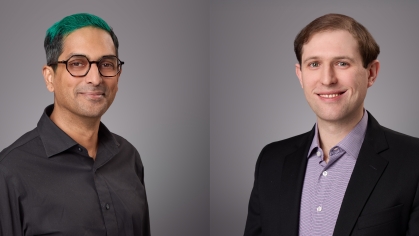
We are pleased to announce that Dr. Salim El Rouayheb, Associate Professor in the Department of Electrical and Computer Engineering, has received a five-year, $7.5 million Multidisciplinary University Research Initiative (MURI) award from the U.S. Army Research Office for the project titled “SOLIR: Stochastic Ontology for Learning: Information Theory Meets Rule-Based Reasoning.” The project is led by PI El Rouayheb at Rutgers University, in collaboration with MIT, Drexel University, the University of Maryland, and the University of Illinois Chicago. Rutgers' share is approximately $1.55 million.
The abstract of the project is below.

AI has transformed inference and decision-making through powerful data-driven learning. While data-driven machine learning approaches excel at discovering statistical patterns, a promising opportunity lies in integrating them with structured domain knowledge (concepts, relationships, and rules) to enable richer contextual understanding and interpretable reasoning. Ontology engineering provides a formal framework for incorporating such knowledge into AI systems, but existing approaches face challenges in efficiently representing and communicating task-relevant information, adapting to uncertainty and evolving knowledge, and operating in decentralized environments. SOLIR aims to address these challenges by bringing together information theory and ontology engineering, two fields that have largely evolved independently despite their complementary foundations. The central idea is to move from representing raw data to representing the information needed for reasoning and decision-making as defined by an ontology, leveraging information-theoretic principles to characterize the fundamental trade-offs between representation cost and the accuracy of the resulting inference and decisions. The research is organized into three interconnected thrusts: (1) establishing information-theoretic foundations for ontological quantization and compression; (2) developing stochastic ontology frameworks that capture uncertainty and adapt to evolving knowledge; and (3) designing ontology-guided decentralized algorithms for robust and communication-efficient learning and inference in networks.
Congratulations to Salim and the entire team on this significant achievement!